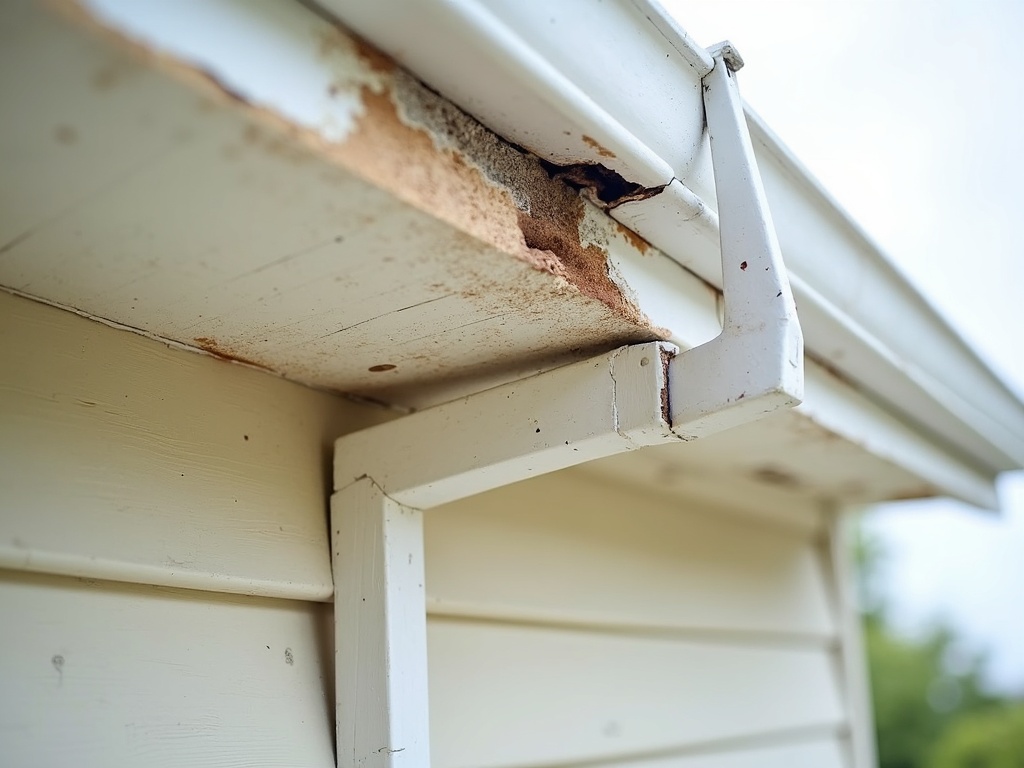
 The Function
 What Your Soffit Actually Does
Soffit is the horizontal panel running along the underside of your roof overhang — the surface visible when you stand at the edge of your home and look up toward the eaves. It closes the gap between the fascia board at the roof's edge and the exterior wall of your home, sealing that cavity from the outside world.
In Georgia's climate, soffit works harder than most homeowners realize. It keeps moisture out of the eave cavity during the state's frequent heavy rains. It prevents the gray squirrels, European starlings, carpenter bees, and other wildlife that are common throughout the Atlanta suburbs and across the state from establishing themselves in your attic. And for homes with vented soffit panels, it provides the air intake that makes your attic ventilation system work — circulating cooler outside air under the roof deck to reduce heat buildup in summer and prevent moisture accumulation year-round.
When soffit fails — whether from rot, storm damage, or animal activity — all three functions stop working at once. The gap left behind becomes a moisture channel and an open door for whatever wildlife is looking for a nesting site that season.
Why Georgia Accelerates Soffit Deterioration
Georgia's humid subtropical climate creates soffit problems through multiple pathways that don't exist in drier parts of the country:
- Year-round humidity — wood soffit absorbs and releases moisture continuously, accelerating rot even in panels that aren't directly exposed to rain
- Summer thunderstorms with horizontal rain — Georgia's convective storms drive water into eave cavities that are never reached by normal vertical rainfall
- Active gray squirrel population — Metro Atlanta's tree canopy supports one of the densest squirrel populations in the Southeast; soffit panels are their primary attic access point
- Older housing stock — many Atlanta-area neighborhoods built in the 1970s through 1990s have original wood soffit that's now past its serviceable lifespan
- Pollen and organic debris — Georgia's extreme pollen season deposits organic material in gutter seams and on soffit surfaces, trapping moisture against the panel face
Signs Your Soffit Needs Repair
Walk the perimeter of your home and look up at the eave line. These are the warning signs that indicate professional attention is needed:
- Panels sagging, bowing, or separating from the fascia — this usually means the nailing channel has rotted through; the panel has lost its support
- Dark staining or visible moisture marks — discoloration that follows the panel seams or corner intersections indicates active moisture penetration
- Holes, chewed edges, or missing sections — a quarter-sized gap is enough for a squirrel; woodpeckers and carpenter bees create similar entry points in wood panels
- Peeling paint on wood soffit panels — paint failure on soffit almost always means moisture is trapped behind the surface; the board is deteriorating from the inside
- Water stains appearing on ceilings near exterior walls — water entering through a soffit gap travels along the rafter line before showing up at the ceiling, often far from the entry point
- Scratching or rustling from the eaves — animals are using your soffit as an access point and are likely already in the eave cavity or attic
How a Professional Soffit Repair Works
A proper repair is more involved than pulling out the damaged section and nailing in a new panel. Contractors approach every job in sequence:
- Full eave inspection from a ladder: The damaged area is never assessed in isolation. The contractor examines the surrounding sections, the fascia board, the gutter line, and the framing visible from below the panel. Problems in one area almost always have a related cause nearby.
- Root cause identification: Was this caused by an overflowing gutter above? Storm wind? Animal entry? Identifying the cause before replacing the panel is what separates a repair that holds from one that fails again in six months.
- Framing assessment: The lookout boards and nailing channel behind the soffit panels are checked for rot before new panels go up. Replacing soffit over deteriorated framing is a guaranteed repeat job.
- Material matching: Replacement panels are sourced to match your existing soffit profile, material, and color. Aluminum panels in the correct profile are almost always available. For older vinyl profiles that may be discontinued, a parts search happens before work begins.
- Installation and sealing: New panels are fitted, secured, and sealed at all seams per the manufacturer specs for Georgia's climate zone. Vented sections are positioned correctly to maintain attic airflow.
- Adjacent entry point sealing: For animal-related repairs, all surrounding gap points — not just the visible entry hole — are sealed before the job is called complete.
Soffit Repair Cost Ranges in Georgia
Pricing depends on the square footage of damaged area, the material involved, and how much structural work is required behind the panels:
| Job Type | Typical Range (Georgia) |
|---|---|
| Small animal entry hole or gap (1–3 panels) | $150–$350 |
| Storm-damaged section (10–20 linear feet) | $350–$700 |
| Full run on one side of home (25–45 LF) | $650–$1,300 |
| Add: framing repair (lookout boards/nailing channel) | + $250–$700 |
| Add: wildlife exclusion sealing | + $150–$450 |
Note: These ranges reflect Georgia labor and material rates as of mid-2026. Your written estimate will be itemized and specific to your home's dimensions and materials. The inspection is always free.
Soffit Material Options for Georgia Homes
Aluminum soffit is the standard choice for most Georgia repairs and replacements. It handles the state's humidity without rotting, holds paint for 15–20 years between repaints, and is available in solid and vented profiles in dozens of colors. Most homes built after 1985 in Georgia already have aluminum soffit — matching it is straightforward.
Vinyl soffit costs less than aluminum and requires no painting, but performance in Georgia's summer heat is mixed. In direct sun, dark-colored vinyl can warp over time. It's a good option for shaded applications or budget-constrained projects in moderate climates within Georgia.
Wood soffit remains on older Georgia homes — particularly in historic districts and neighborhoods built before 1970. When it deteriorates, most contractors recommend converting to aluminum rather than replacing in kind. The ongoing maintenance obligation of wood soffit in Georgia's humidity is difficult to justify unless the home's character requires it.